Spot defect trends
Your run history already holds the pattern. We analyse past runs against their outcomes to show which process signatures keep preceding cracked boules, twinning and inclusions, so a recurring failure mode stops being a surprise.
Crystal growth, without the guesswork.
Starting with predictive maintenance: we catch thermocouple drift and degradation before it costs you a run.
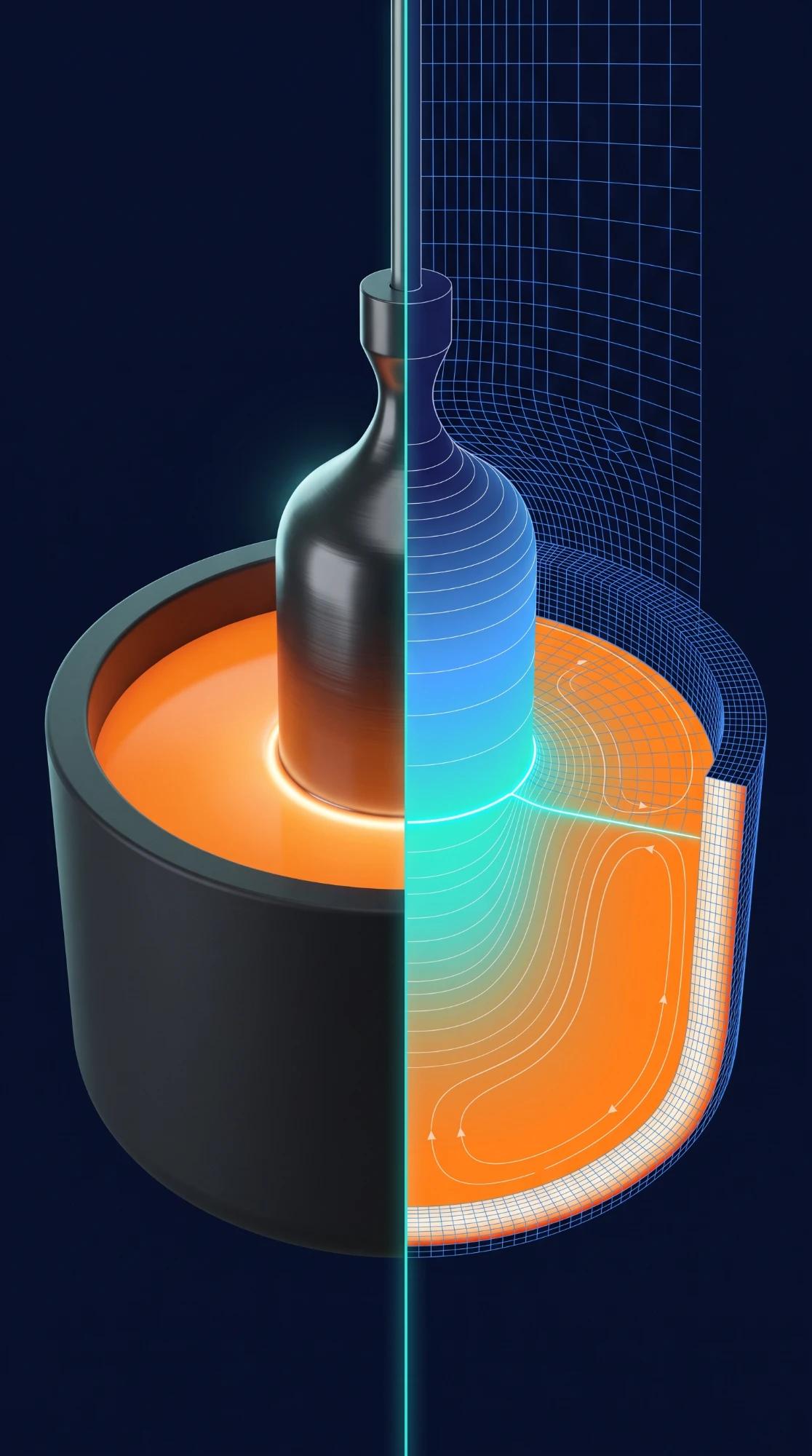
A boule takes weeks to months to grow. For all of that time the only window into it is instrument data: thermocouples, heater power, pressure, rotation. The crystal itself is sealed inside a hot zone nobody can see into.
The checks that settle quality arrive afterwards. Metrology on a cut wafer tells you what happened weeks ago, long past the point where anything could have been done about it.
And the margins are thin. Growth holds a gradient to fractions of a degree, so a sensor reading half a degree off moves the real gradient while every screen still shows the setpoint.
The cost shows up as runs lost at the end, furnaces down without warning, and months of capacity spent to learn one thing.
No new sensors, no data overhaul, and no change to how you run. Each one stands on its own, and each one makes the next one better.
Your run history already holds the pattern. We analyse past runs against their outcomes to show which process signatures keep preceding cracked boules, twinning and inclusions, so a recurring failure mode stops being a surprise.
During a run we compare live process data against what a healthy growth looks like on your furnace. A run going off track shows up while there is still time to act, instead of at metrology weeks later.
Thermocouples drift, and half a degree is enough to change how a crystal cools. We track how your sensors behave relative to each other, quantify the drift, and call a replacement before it costs a run or takes a furnace down unexpectedly.
Growing a crystal a particular way means holding a gradient to fractions of a degree. When a thermocouple reads half a degree off, the furnace holds a gradient nobody chose, the crystal cools along a different profile, and the run is lost. We find those errors by reading how your thermocouples behave relative to each other, across millions of past readings and the thousands arriving from the run in progress. This is the work we deliver today.

Vertical scale exaggerated. Real drift of this kind is a fraction of a degree and does not show on a furnace readout.
Drift is inherent to thermocouples. It is gradual, and small enough that no engineer can track it by hand across every sensor and every run, so it stays invisible until a run comes out wrong or a furnace stops unexpectedly.
Half a degree of error is enough to change how the crystal cools. The controller corrects toward the wrong number, the screen still reads the setpoint, and the real gradient moves away from the one your recipe calls for.
Each sensor on its own looks healthy. What moves first is how the sensors sit relative to one another: which reads warmer, by how much, at which stage of the run. Machine learning and deep learning models weave together millions of readings from your run history and the thousands coming off the furnace now, and surface the subtle shifts in those relationships. Drift becomes a number you can act on and a replacement you can schedule between runs.
Most growers aren't ready to adopt off-the-shelf simulation software, and they shouldn't have to be. Before a twin can predict anything, the data beneath it has to be trustworthy. That's the work we do with you, and every layer is useful on its own.
What-if runs and predictions your team uses.
See during a run whether it's on track, while there's still time to act.
Learn what normal looks like for each heater, thermocouple and sensor, so drift is caught before it costs a run.
Clean pipelines, data quality, validation and the infrastructure to keep it running.
That's why we start with discovery, not a demo.
How we work“I truly believe a simulation for crystal growing would be a valuable tool.”
We are machine learning engineers working alongside a process engineer who spent the better part of a decade inside compound semiconductor manufacturing, on crystal growth.
The same pattern kept showing up. The signal that explains a failed run is already sitting in the furnace data, but nobody has the time or the tooling to pull it out while it still matters.
So we started building the tools we wanted back then: models that read your own process data and hand your engineers something they can act on, beginning with the sensors the whole process depends on.
Expertise from
This is a partnership rather than a product drop. We work alongside your engineers, on your furnaces and your data, for as long as the phase takes, and nothing here is software you install and are left to run. A pilot is scoped small on purpose: you set the criteria before it starts, and every phase leaves your team something it keeps.
We work with the data your furnaces already produce. No new sensors, no rip and replace.
We establish what normal looks like for each furnace and each sensor, and report what the data shows.
Drift detection and run monitoring your team can act on, measured against criteria you set.
What works on the pilot furnace rolls out to the rest, and to the next capability.
Tell us about one furnace: what you grow, what you already measure, and where runs go wrong. No deck, no preparation and no commitment. You will know by the end of it whether there is something worth pulling out of your data.